
Kitchen Ninja — Knife Thrower
BluetileCasual
4.7214.00 Reviews
- Version
- 1.3.0
- Installs
- 100.00K
- Age Rating
- Everyone
Screenshots
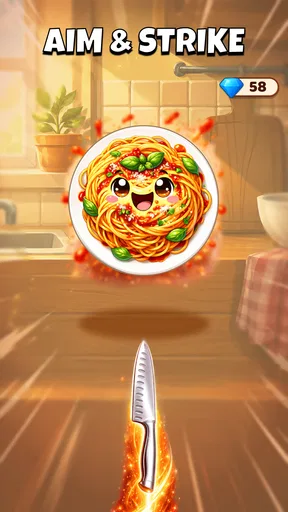
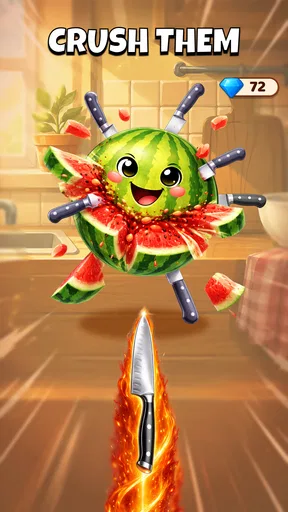
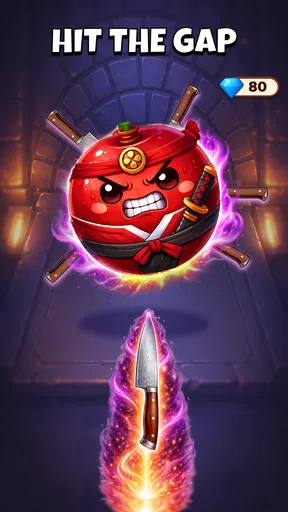
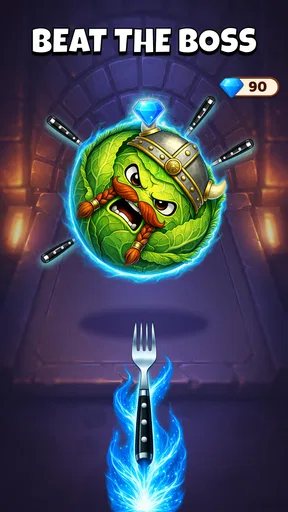

Our Review of Kitchen Ninja — Knife Thrower
 Analysis by Appyee
I spent time with Kitchen Ninja — Knife Thrower as a quick, casual game, and its appeal is easy to understand: it turns a simple kitchen-themed idea into short bursts of timing and aiming. You throw knives at unruly fruit and vegetables, trying to land clean hits while keeping your attention on the target. It is the kind of game I can open without preparation, play for a few minutes, and put down just as quickly.
That simplicity is both its strongest quality and its main limitation. This is not a deep action game with a large world, a long story, or complicated controls. It is a focused casual game from Bluetile, built around the satisfaction of getting a throw right. If you enjoy compact reflex challenges and want something light for spare moments, it is worth considering. If you need long-term progression or a more substantial single-player experience, you should approach it with more modest expectations.
How this kitchen-themed challenge fits into everyday play
The game’s store summary describes the central idea clearly, but the practical appeal comes from how little commitment it asks from me. I do not need to remember a complicated plot or relearn a control scheme after a break. The kitchen setting gives the action a playful identity, while the knife-throwing concept keeps each attempt focused on timing, positioning, and avoiding careless moves.
I found that it works best as a short reset between other tasks. For example, after finishing a commute or waiting for an appointment, I can play a few rounds without feeling that I have started something that demands a long session. That makes it a better fit for brief breaks than for an evening when I want a game to absorb my attention for hours.
The controls are approachable in spirit, which matters for a game aimed at Everyone. A younger player can understand the objective quickly, while an adult can still enjoy trying to improve consistency. The age rating also makes it easier to recommend as a light family-friendly option, although the knife-throwing theme may still be less appealing to people who prefer purely non-violent puzzle games.
One useful way to approach it is to treat every attempt as a timing exercise rather than rushing to throw immediately. Watching the movement of the fruit and vegetables before committing can make the game feel less random and more skill-based. I also found that short, deliberate sessions were more enjoyable than repeatedly playing while distracted, because a small lapse in attention can turn a promising run into a frustrating one.
What the free entry point really means
The game is free to download, so there is no upfront purchase required to find out whether its basic loop suits you. That is an important advantage for a casual title: I can test the controls and overall feel without paying first. The listed in-app purchases range from $2.99 to $14.99 per item, so the free starting point should be viewed separately from the potential cost of optional purchases.
I would not automatically treat those items as necessary for enjoying the game. The sensible approach is to begin without spending, decide whether the repeated throwing challenge remains entertaining, and only then consider whether an optional purchase adds enough value for your habits. A free game can be good value when it provides enjoyable short sessions without pressuring me to buy immediately, but the value calculation changes if I feel pushed toward purchases to keep playing comfortably.
Because the purchase prices are presented per item rather than as one fixed full-game price, I would be cautious about comparing it directly with a premium casual game. A paid alternative may offer a clearer cost from the start, while this title lets me try it first. Neither model is automatically better; the right choice depends on whether I prefer testing a free game or paying once for a more predictable package.
Where the game delivers its value
The main value is not in a large quantity of content that I can measure by hours. It is in the convenience of a compact challenge that is immediately understandable. The fruit-and-vegetable targets give the game a recognizable personality, and the knife-throwing action provides a clear reason to replay a round: I want to make a cleaner attempt than the last one.
That replay motivation is strongest for players who enjoy small improvements. If you like noticing that your timing has become steadier, or you enjoy concentrating on one action until it feels natural, the game can provide satisfying moments without requiring a complicated progression system. It is also suitable for people who prefer games that can be enjoyed with sound low or off, since the visual action is central to understanding what is happening.
A practical tip is to use it as a deliberate focus break instead of opening it whenever you are already overstimulated. Give yourself a short target, such as completing a few careful attempts, then stop while the challenge still feels fresh. This prevents the repetition from becoming tiring and makes the game’s compact design work in its favor.
Another useful trade-off is precision versus speed. Throwing as soon as possible may feel exciting, but observing the target first can produce more reliable results. Players who naturally rush may initially find the game less forgiving, while patient players may discover that the simple controls leave room for meaningful improvement. That distinction is easy to miss from the store description, but it affects whether the game feels skillful or merely repetitive.
Compatibility and realistic expectations
The current version is 1.3.0, and the minimum operating system is Android 7.0. That makes the compatibility requirement relatively approachable for many Android users, though anyone with an older device should check the system version before trying to install it. The install figure is over 100 thousand, and the average rating is 4.7 from around 9.9 thousand ratings, which suggests that the straightforward concept has found a receptive audience.
I would still avoid treating a high average rating as proof that every player will enjoy it. Ratings often favor people who already like the game’s particular rhythm. Someone looking for a story-driven adventure, a strategic card game, or a large collection of modes may find the experience too narrow even if the casual audience rates it highly.
The game’s size and simple premise also make it a reasonable candidate for keeping on a phone as a spare-time option rather than as a primary game. I would install it for quick access when I want something uncomplicated, not as a replacement for a more involved title. That distinction helps set the right expectation before downloading.
Trade-offs that matter after the first few sessions
The biggest trade-off is focus. A tightly defined knife-throwing loop can feel refreshing because there is little clutter, but it can also become repetitive if the basic action does not hold your interest. I enjoyed the immediacy, yet I would not recommend it to someone who needs frequent changes of setting, characters, or objectives to stay engaged.
The second trade-off concerns spending. Free access lowers the barrier to entry, but optional purchases priced from $2.99 to $14.99 can make the total value less straightforward than a one-time paid game. I would set a personal spending limit before buying anything, especially if the game is being played by a child. The Everyone rating does not remove the need for sensible purchase controls on a shared device.
There is also a difference between casual accessibility and lasting depth. The easy-to-understand premise is ideal when I want to start playing immediately, but it gives the experience less room to surprise me than a game built around exploration or evolving systems. If you normally judge value by the number of distinct activities available, this may feel limited even when the individual throws are enjoyable.
Compared with ordinary reflex games, its kitchen theme gives it more character than a completely abstract target challenge. Compared with puzzle games, however, it places more emphasis on reaction and timing than on planning several moves ahead. Compared with premium casual games, the free entry point is more inviting, while the presence of optional purchases means the eventual cost may be less predictable. Those are the comparisons I would use when deciding where it belongs on my phone.
Who is most likely to get good value
I would recommend it to someone who wants a low-commitment game for short breaks, especially if they enjoy aiming, timing, and repeating a simple action until it feels more controlled. It can also suit families looking for an Everyone-rated title with an immediately understandable objective, provided an adult manages purchases and decides whether the knife theme is appropriate for the household.
It is a particularly good match for players who do not want to read instructions for several minutes before starting. The premise is clear, and the kitchen setting keeps the presentation light rather than overly serious. I can imagine keeping it installed alongside larger games as a small, dependable option for moments when I have only a few minutes.
I would skip it if your ideal mobile game needs a campaign, character development, multiplayer competition, or a broad set of mechanics. I would also choose a different option if you dislike repetition or find timing-based games stressful. A more traditional puzzle title will be better for someone who wants to think through solutions at their own pace, while a premium game may be preferable for someone who wants one clearly defined purchase instead of optional item spending.
For parents, the free download is convenient, but I would review the device’s purchase settings before handing it to a child. The game’s age rating makes it broadly accessible, yet the listed in-app purchase range means cost control still matters. That is a practical step worth taking before the first play session, not after an accidental purchase.
Spending, competition, and the questions I would ask
The purchase details make the starting decision simple, but they do not settle every question about long-term value. I can confirm that the game is free to download and that optional items cost between $2.99 and $14.99 each. Whether those items affect progress, change the play experience, or are purely optional in practice is not clear from those facts, so I would not treat them as either essential or harmless without checking what a specific purchase offers before confirming it.
That uncertainty also matters if you are wondering whether spending gives an advantage over other players. I have no verified basis for calling the game competitive or saying purchases influence rankings, so I would judge it as a personal reflex game rather than assume there is a fair-play system to evaluate. If competition is what you want, a title with clearly explained multiplayer rules and purchase effects would be a safer choice.
For a typical day, I would use it in a small gap rather than make it the main event: waiting for a takeout order, taking a break between chores, or unwinding for a few minutes before bed. I would stop when I notice myself throwing impatiently instead of watching the targets. That is a useful personal limit because this kind of repeated action is most satisfying when I am attentive, and it gives me a natural way to avoid turning a quick distraction into a dull stretch of play.
One practical decision point is whether you want a game that rewards a brief burst of concentration or one that gives you a task to solve at your own pace. The knife-throwing premise points toward the first. If you are tired, multitasking, or looking for something calming with no timing pressure, a relaxed word or logic puzzle is likely to suit you better. If you enjoy trying to make a small action more consistent, this game has the more immediate appeal.
My recommendation after weighing the cost and limits
The best reason to try this knife-throwing game is its low-risk, quick-session format. I can start for free, learn the central action almost immediately, and decide based on actual play rather than guessing from a description. Bluetile has chosen a narrow concept, but that narrowness is useful when I want a focused distraction instead of another demanding game competing for my time.
The free access gives it a fair chance, while the optional purchases mean I would keep spending separate from the basic recommendation. I would enjoy the game without assuming that buying an item is required, and I would only spend if a particular purchase clearly improved my own experience. For me, that makes it more attractive as a casual download than as a game I would invest in heavily.
My final verdict is positive but specific: try it if you want a playful timing challenge that fits naturally into short breaks. Do not choose it expecting a deep progression system or endless variety. With a 4.7 average from around 9.9 thousand ratings and over 100 thousand installs, it has clear appeal among casual players, but its real strength is personal convenience rather than scale. Kitchen Ninja — Knife Thrower earns a place on my phone as a quick, free-to-start distraction, provided I keep its focused design and optional purchase model in mind.
Verdict
Strengths of Kitchen Ninja — Knife Thrower
- Simple controls make knife throwing easy to learn.
- Quick rounds are ideal for short gaming sessions.
- Increasing targets provide a satisfying sense of progress.
- Offline play makes it convenient when no internet is available.
- Bright visuals and sound effects make hits feel rewarding.
Limitations of Kitchen Ninja — Knife Thrower
- Gameplay can become repetitive after extended play.
- Precise timing is difficult on smaller phone screens.
- Missed throws may feel frustrating during later levels.
- Limited variety can reduce long-term replay value.
- Ads may interrupt the experience between rounds.
Other Releases by Bluetile
View All

Ball Sort Puz - Color Game
Puzzle4.8

Water Sort Puz - Color Game
Puzzle4.8

Dot Link - Connect the Dots
Puzzle4.8
Similar Picks in This Category
View All
My Talking Angela
Outfit7 Limited4.2

My Talking Tom
Outfit7 Limited4.3

Pou
Zakeh4.2

My Talking Tom 2: Pet Game
Outfit7 Limited4.3

Candy Crush Saga
King4.6

Bridge Race
Supersonic Studios LTD4.1
Frequently Asked Questions
What is Kitchen Ninja — Knife Thrower?
Kitchen Ninja — Knife Thrower is a casual arcade game focused on timing, precision, and quick reactions. The main objective is to throw knives at rotating or moving kitchen-themed targets without hitting knives that are already stuck in the object. As you progress, levels generally become more challenging, requiring better timing and concentration. Its simple controls make it easy to understand, while the increasingly difficult stages provide a reason to keep playing.
How do you play Kitchen Ninja — Knife Thrower?
The gameplay is designed to be straightforward, making it suitable for short sessions. Players typically tap the screen to launch a knife toward the target, carefully choosing the right moment to avoid obstacles and previously thrown knives. Successful throws help complete the level, while an inaccurate throw can end the attempt. Although the controls are simple, later stages demand patience, rhythm, and careful observation.
Is Kitchen Ninja — Knife Thrower free to download and play?
Kitchen Ninja — Knife Thrower is generally presented as a free-to-download mobile game, allowing users to try its core gameplay without paying upfront. However, availability of advertisements, optional purchases, extra items, or other monetization features may depend on the version and platform. Before downloading, it is worth checking the official store listing for current pricing details, in-app purchase information, and any regional differences.
Does Kitchen Ninja — Knife Thrower require an internet connection?
The basic knife-throwing gameplay may be playable without a constant internet connection, which makes the game convenient for quick entertainment while traveling or when mobile data is unavailable. Nevertheless, certain functions—such as advertisements, store features, updates, cloud-related services, or promotional content—could require connectivity. Players should also remember that offline availability can vary between versions and may change after future updates.
Is Kitchen Ninja — Knife Thrower suitable for children?
Kitchen Ninja — Knife Thrower uses cartoon-style knife-throwing gameplay rather than realistic violence, so its presentation may be appropriate for players who enjoy casual arcade challenges. Even so, parents should review the age rating, advertising policy, and in-app purchase settings on the relevant Android or iOS store. Difficulty can also become frustrating for younger children, particularly when levels require precise timing and repeated attempts.
Play our best games!


